The short answer
- A bed alarm alerts a caregiver to movement according to its sensor design.
- A bedside mat changes the surface beside the bed but must not create a trip hazard.
- Use either product as part of a clinician guided safety plan.
Bed alarms and bedside floor mats are sometimes used when a person needs additional monitoring around the bed. They serve different purposes. An alarm provides a signal when its sensor is activated. A floor mat provides a different surface beside the bed.
Neither product can guarantee that a fall will not happen. If someone has repeated falls, confusion or difficulty getting out of bed, ask the person’s doctor, nurse, physical therapist or occupational therapist to assess the situation.
How does a bed alarm work?
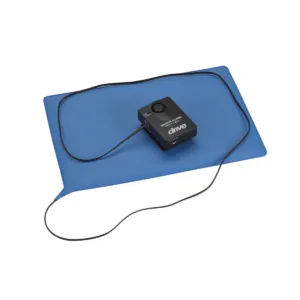
Bed alarm systems use a sensor that detects a change such as pressure, movement or another trigger, depending on the design. When the trigger occurs, the system sounds an alert or sends a signal to a connected unit.
The alarm is intended to notify a caregiver. It does not physically stop the person from moving.
Where is the sensor placed?
Placement depends on the alarm type. A pressure pad may sit on the bed according to the manufacturer’s instructions. Other sensors may attach to clothing, a chair or another location.
Use the exact placement described by the product. Incorrect positioning can affect how the alarm responds.
Who needs to hear the alarm?
Before relying on an alarm, think about where the caregiver will be. The alert needs to be loud enough or transmitted in a way that the caregiver can notice.
Check the alarm in the actual home environment. Closed doors, televisions and distance can affect whether a sound is heard.
What is a bedside floor mat?
A bedside mat is placed on the floor near the bed. Different products use different materials and thicknesses.
The mat should be positioned according to the manufacturer’s instructions and should not curl, slide or interfere with mobility equipment.
Can a floor mat create a trip problem?
Any object placed on the floor can affect walking or rolling equipment. Check the edges and thickness of the mat.
If the person uses a walker or wheelchair, make sure the mat does not block the normal route. A therapist can help decide whether the mat fits the person’s safety plan.
Should the bed be changed too?
Bed height, mattress thickness, rails, assist handles and the person’s transfer technique all interact. Do not focus only on the alarm or mat.
If bed height is part of the concern, ask a clinician to review the complete setup before changing it.
What about bed rails?
A bed rail is a separate piece of equipment and is not automatically an appropriate solution for someone at risk of falling. Rails can introduce other concerns when they do not match the person, bed or mattress.
Use rails only when they are part of an appropriate care plan and installed according to their instructions.
How should an alarm be tested?
Follow the manufacturer’s test procedure. Check the batteries or power source, sensor connection and alarm controls.
Caregivers should know how to silence, reset and retest the device. Do not simply turn off an alarm that activates repeatedly without understanding why.
What mistakes are common?
- Treating an alarm as a substitute for supervision.
- Placing the sensor in the wrong location.
- Using an alarm that cannot be heard where the caregiver is located.
- Putting a thick or loose mat directly in a walker path.
- Adding bed rails without assessing the complete bed setup.
- Ignoring repeated alarms instead of reviewing the cause.
What should you compare before buying?
For an alarm, check sensor type, alert method, power source and how the caregiver receives the signal. For a floor mat, check dimensions, thickness, edge design and placement requirements.
Then review how the product fits with the person’s bed, mobility equipment and supervision plan.
If you are unsure which monitoring equipment fits your setup, call an Avante Shop specialist for help.
Questions people ask
Will a bed alarm stop someone from falling?
No. It is designed to alert a caregiver when its sensor is triggered. It does not physically prevent movement.
Can a floor mat be used with a walker?
It depends on the mat and the person's mobility plan. Make sure the mat does not create an obstacle in the walking route.
Should a bed alarm be tested?
Yes. Follow the manufacturer's test procedure and make sure the caregiver can receive the alert.
Does a bed rail replace an alarm?
No. Bed rails and alarms serve different purposes and both require individual assessment.
This guide is general product information, not medical advice. If you are unsure what is right, speak to your doctor, nurse or therapist.